
131·
6 months agoFixed it

Fixed it
Beautifully written!
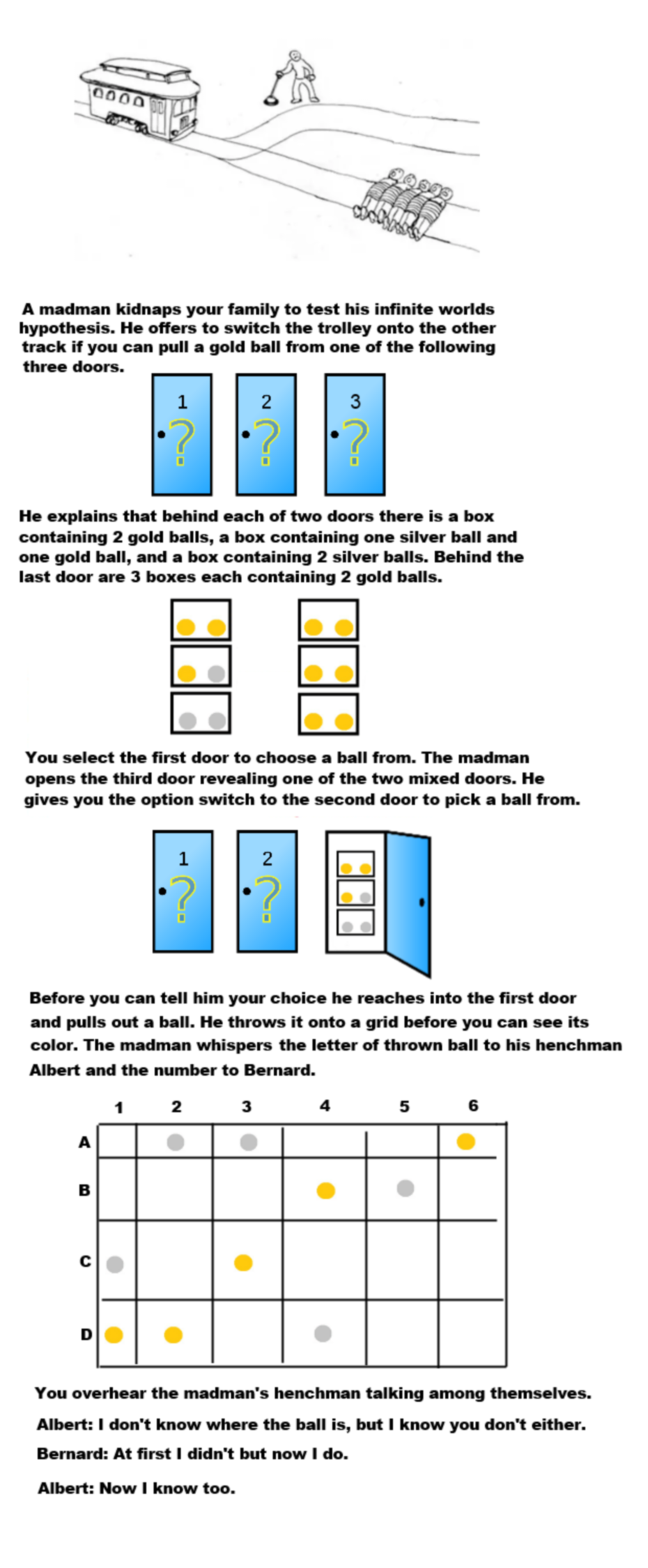
I think the probabilities cancel out?
My conclusion as well. Except that since Jigsaw has taken one gold ball out, door 2 must have slightly better chance of gold ball remaining on average (75% vs 72.2%?).

Gravity—the curvature of space-time—can’t stop changes in the curvature of spacetime from propagating outward.
This is false. If it were true, you could build a device to communicate from inside a black hole event horizon. By waving around a heavy ball you would create gravitational waves that a sensitive enough LIGO outside the black hole could detect. But this is impossible. You would create gravitational waves, yes, but they would fall towards the center singularity same as you, and will never penetrate and escape the event horizon.

That allows sending packets inside the VPN tunnel, but the outer envelope packets still need to be able to reach the VPN server.
sudo ufw default deny outgoing
I’m guessing this would block the VPN packets themselves as well.
My guess is that no to the first, since I have a 1/3 chance of being in the forked path, vs 1/15 of being in the straight path and my lever being connected.
Suppose you live in a kingdom where everyone is as selfish as you, and you’ve seen on TV many situations exactly like this one where people were tied to the tracks - usually one at a time and occasionally 10 at a time. (The villain has been prolific.) You’ve seen them all follow this logic and choose not to flip their switch, yet out of ~1500 people you have seen in peril this way, ~1000 of them have died. If only their logic had convinced them (and you) otherwise, 1000 of them could have selfishly survived! Doesn’t seem very logical to follow a course of action that kills you more often than its opposite.
(If you don’t want to imagine a kingdom where everyone is selfish, you can imagine one where x% are selfish and (100-x)% are altruistic, or some other mixture maybe with y% of people who flip the lever randomly back and forth and z% who cannot even understand the question. The point is that the paradox still exists.)
Edit: I can see now how in a 100% altruistic kingdom, where you are the only selfish one and you know for sure that everyone else will logically altruistically pull the lever, it makes sense for you to not pull the lever. Presumably there is some population x% split (44% selfish/56% altruistic?) where your selfish decision will have to reverse. Weird to think that your estimate of the selfishness of the rest of the population has a relevance on your decision!

Oh! They don’t mean that black holes must come in perfect pairs! The headline makes it sound like it’s about wormholes across vast distances. No! What they’ve found is a stable “orbit” solution for the two-body problem. Normally when you place two bodies anywhere in an empty universe, they will gravitate towards each other until they collide. But in a universe with dark energy, there is some perfect distance between them, where the accelerating expansion perfectly counterbalances the accelerating attraction. They’ve used general relativity math to actually calculate such an arrangement.
The “stable” orbit in this case is the same kind of stable as a pencil balanced on its sharp tip - if it tilts even slightly one way it will fall out of control. Although they tantalize the idea that they might be able to make it truly stable against small perturbations once they finish their spinning black hole solution.
I would like to have known some specific numbers examples! Like if you have as much dark energy as our universe, and two 10-solar-masses stellar black holes, how far apart would that be? Is it like 1Ly or 1MLy? How far for two 10-million-solar masses supermassive black holes? The formulas they created should give the exact answer but I am not skilled enough to substitute the correct numbers for the letters.

Both this paper and the delayed choice quantum eraser experiment paper (arXiv:quant-ph/9903047) only show a single blob, not the double stripe. If anyone has a paper that clearly shows a photo with the double stripes the way it’s shown in the classic monkey meme, I’d like to add it to my collection!
Obviously if the slits are big and wide enough apart you will just get two spotlights, so that doesn’t count. It wouldn’t even demonstrate wave physics, let alone quantum. It has to be a paper where there is some switch you turn on or some filter you slide in place or whatever that makes the image on the physical screen toggle between two stripes and multiple.
If we cover one slit, it will look like figure 3, shifted to the side and at half intensity.
The paper doesn’t use an actual screen, they only have the detector D_S that they move up and down to record the coincidences. I simulated what the monkey would see had there been a screen in place for the purpose of the meme. I copied down the datapoints from the graph and simulated 100,000 photons hitting the screen with the probabilities indicated by those points. My javascript pastie is available here: https://html.cafe/xcd2a5ed3?k=19f51bff26c65bcf253ee5257a5257d4f11570d9 Importantly, the monkey can never see images 4 and 5 on the physical screen - those can only be displayed on the computer. The monkey will only ever see image 3, which is the sum of 4 and 5.


End of Eternity (1955) by Isaac Asimov (and its reimagining in Palimpsest (2009) by Charles Stross) involve a time-traveling secret organization that has its headquarters hidden away in time/outside of time. They don’t so much drain resources though as manipulate history to ensure a safe course.