
Michael Murphy (S76)
- 13 Posts
- 12 Comments
Joined 3 years ago
Cake day: June 12th, 2023
You are not logged in. If you use a Fediverse account that is able to follow users, you can follow this user.
 1·1 year ago
It does work like this, but as with justice, the wheels can be slow at times.
I’d recommend everyone to try out
cosmic-storewhen they get a chance. Whether you use COSMIC or not, it’s fully functional with any desktop environment. It’s packaged by default in Pop!_OS 22.04, available in Fedora 40 via ryanabx/cosmic-epoch, and the AUR.

How so? 22.04 is actively maintained and updated by Ubuntu, and is still the latest LTS release. On top of that, the most important packages in Pop!_OS are updated frequently, so we are on Mesa 24.0.3 and Linux 6.8.0. As for when COSMIC releases, you should read last month’s blog post.
All desktops use the Super key nowadays. Sway, i3, GNOME, Plasma, etc. are all using the Super key. Have been for years. The standard convention is that the Super key is reserved for system-level shortcuts handled by the window manager; and Alt key shortcuts are reserved for application-level shortcuts. Your desktop might have bound both Alt and Super because of legacy reasons.
You might be surprised how much disk space those GNOME Circle applications actually require, despite being dynamically linked to a lot of GTK/GNOME libraries. Unless they’re written in a scripting language, they’re much closer to a COSMIC application than you think.
- https://flathub.org/apps/org.gnome.TwentyFortyEight 12 MB
- https://flathub.org/apps/org.gnome.Reversi 12 MB
- https://flathub.org/apps/org.gnome.NetworkDisplays 13 MB
- https://flathub.org/apps/org.gnome.eog 12 MB
- https://flathub.org/apps/org.gnome.Photos 29 MB
- https://flathub.org/apps/org.gnome.Notes 12 MB
- https://flathub.org/apps/org.gnome.gedit 20 MB
- https://flathub.org/apps/app.drey.Warp 22 MB
- https://flathub.org/apps/com.github.flxzt.rnote 41 MB
- https://flathub.org/apps/io.gitlab.news_flash.NewsFlash 42 MB
I don’t see the issue with an application having a static binary within the realm of 15-25 MB. Even if you had 100 applications installed, that’s only 2 GB of disk usage.
I wouldn’t rule out the possibility of a cosmic-applets-community package which bundles third party applets, or the gradual inclusion of popular applets into cosmic-applets. Given that an applet would only become popular if there’s a lot of need for those use cases, then it would make sense to open a path to getting them mainlined.
That’s already happening
I assume you meant Pop!_OS instead of COSMIC. Pop!_OS 24.04 will be based on Ubuntu 24.04.
Static linking is not an issue. Binaries may require more space on disk, but the benefit is that they are self-contained, portable, with excellent performance, and low memory usage. Binaries are compiled with LTO, so unused functions are stripped from the binary. What remains is highly optimized to that application’s use cases.
Translation: no one should ever attempt to innovate on the Linux desktop. GNOME is the epitome of software development and everyone else should quietly give up. If GNOME can’t fix an issue, no one can. Only GNOME has the god-given right to make decisions on how desktops are developed for Linux. There can only be one party. The One Desktop principle. Contribute to your party leader, or else…
Because that’s not how software development works, and that’s not how you make progress in the field. In order for our technical vision to be integrated with an existing desktop, such as GNOME, it would have required that they give us the reigns to their project to delete their entire codebase and rebuild it into exactly what you see today in COSMIC.
As in life, sometimes you’ve got to demolish, pave, and build better foundations. There’s a lot of cool technologies available to build a truly next-generation desktop experience in, but you’re not going to get it through rigid bureaucracy and old tools. With COSMIC, we’ve got freedom to make decisions and build something truly unique, and we’re using our talent to show you what we can do.



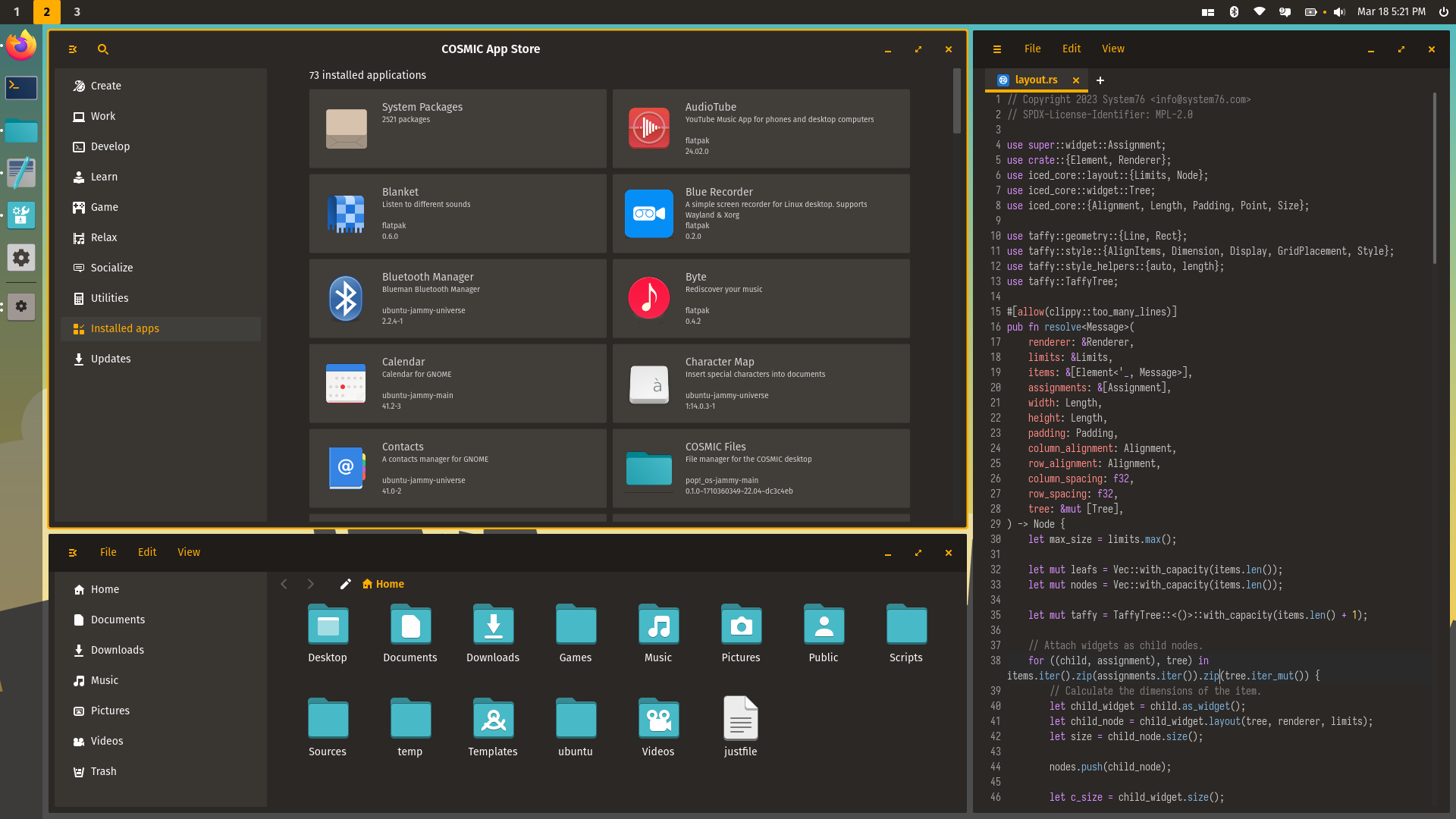

The alpha began in August of last year, and will continue to be classified as alpha until all features are finished.